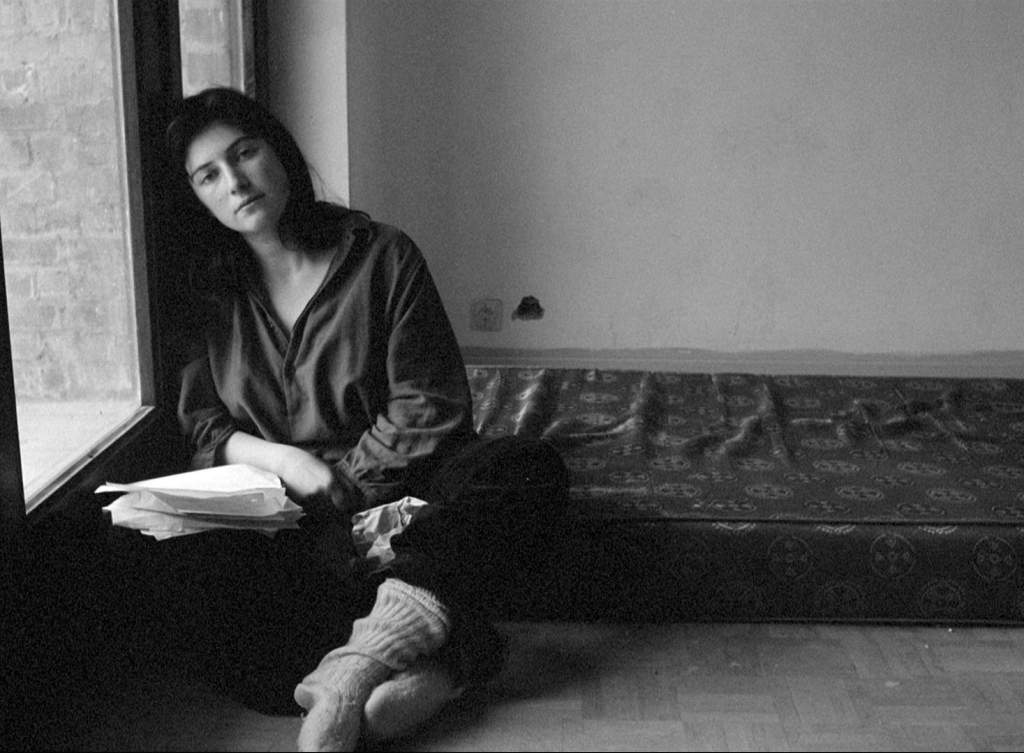
One haunting image from the film, Je Tu Il Elle (1974; I You He She), is when Julie, the young woman played by the director, Chantal Akerman, has shifted furniture out of her ground floor apartment, and has moved her bed against the wall. Sitting against an alcove in the corner of the room, near the main window, Julie is cast in shadows within this cheap-looking white room. As the light fades outside, the image darkens and Julie almost visually disappears. Akerman’s film is shot in black and white, and has a stark simplicity in locked-off master shots. We’re stuck there with Julie, almost observing her as an exhibition. Then there’s a rigorous formalism and commitment to boredom here, to slow cinema and existing in dragged-out moments through unbroken, static shots. Je Tu Il Elle has three basic acts and it’s the first act that sets the film’s tone as we just sit with Julie existing in this room. We hear voice-over narration that anticipates the proceeding action, sometimes delivered, a few times contrasted with surprise. Julie sits or lies down, writes letters, and rewrites them, takes off their clothes and stands nude by the window, and eats spoonfuls of sugar from a paper bag. I must admit my attention drifted sometimes and I was lulled into the occasional sleep. It’s taxing, but it puts you in this character’s headspace – boredom, depression, ennui. It is a relief when we shift to the next parts – the second act being Julie hitch-hiking on the road and spending time with a sleazy male truck driver (Niels Arestrup), where she’s a mostly silent passenger, either in the truck or in the bars they frequent, and the third act, being a reunion with Julie’s past lover, an unnamed woman (Claire Wauthion), and the fleshy slap of their bodies together in the climax’s prolonged sex scene. The first act is so important in setting up the interiority of the character, and the contrasts in their relationships with two different characters, and the sexuality displayed. I am really taken with Chantal Akerman’s artistry and work as a filmmaker; each movie I see of Akerman’s feels of a piece with their long-life obsessions and themes, but are also portraits of a time in their lives, this film in particular feeling very representative of an early twenties experience. I watched the Criterion Collection DVD of Chantal Akerman In The 70s – though the film is also available on Criterion Channel. Recommended.

 VHS Tracking