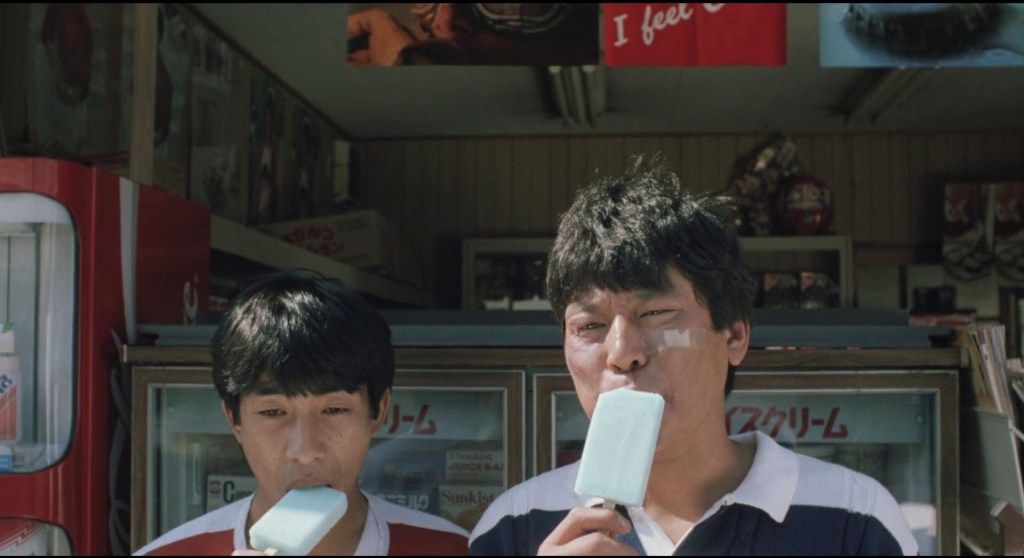
Takeshi Kitano treats violence with the same structural impact as building a gag in comedy. Boiling Point (1990) veers between violence as a joke – a call back, or a punchline, like when a young kid refuses a helmet on his first motorcycle, and then cut to him sitting stunned with a bloody face – and violence as cruelty – a knife in the guts, a machine gun sprayed across an office. Kitano’s approach to cinema blurs the two often, and Boiling Point has a curious tone, enhanced by the lack of score and the use of silence and stillness. Even Kitano is only a supporting character here who doesn’t show up until more than halfway through.
Instead, our protagonist Masaki (Yūrei Yanagi) is a gormless blank slate, a young car mechanic and amateur baseball player, who stands and watches the game passively, even when prodded to play. The focus on amateur baseball, and the eventual deviation into yakuza related violence, feels disconnected and strange. The more I thought about it, the more there’s a thematic tie. Our blank hero is pushed to play baseball, to practice swinging his bat a hundred times a day. When he eventually gets into trouble with a yakuza lieutenant not happy with his car service, this is another arena he is provoked to play in. Kitano’s filmography carries on with this brutal truth, right up to a proper yakuza film like Outrage: you hit, and then you get hit. You can have a bat in hand, punch a guy out, do it for revenge, and eventually you’ll be struck down, somebody else has the bat in hand. Everyone has a turn and none of the players are let off the hook. Even Kitano as pure id, a bisexual gangster who continually assaults those around him, and is delighted by his capacity for cruelty.
I enjoyed the deadpan humour, the off-putting violence and the flashes of beauty. Boiling Point is often talked about as a transitional film for Kitano, bringing in his authorial sensibility (this was his first original script, Violent Cop was him rewriting somebody else’s) and eventually leading to the stronger vision of Sonatine. I think there’s something distinctive about Boiling Point’s rambling, strange tone, the collision of tones and genres (coming of age, sports, hang-out, gangster flick) and the way you can interpret the ambiguous ending. Streamed on Tubi (US). Recommended.

 VHS Tracking