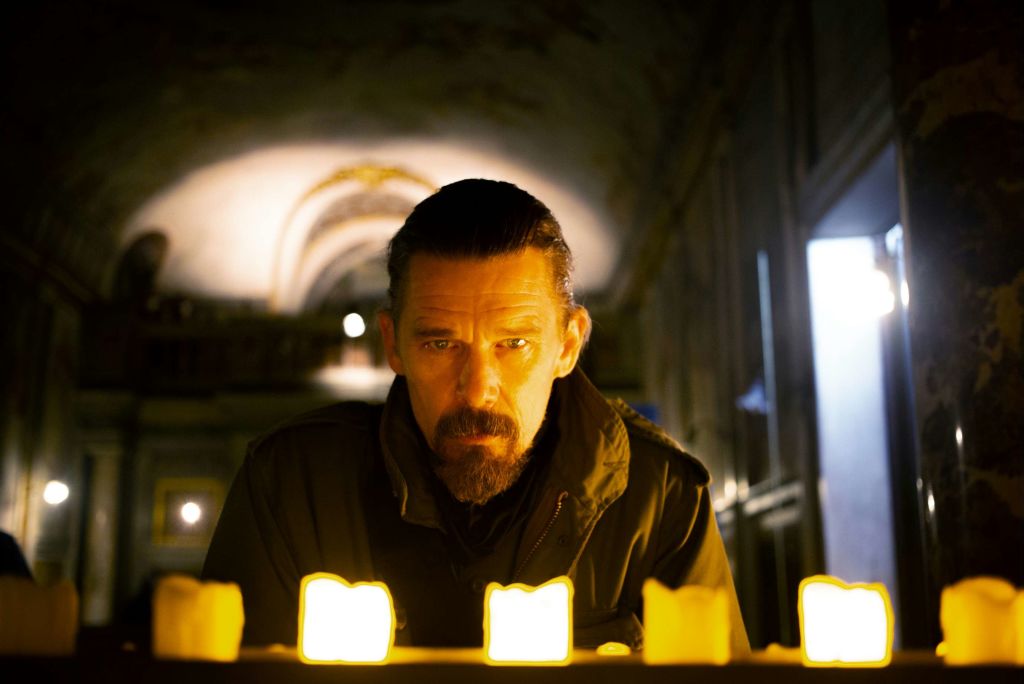
I wonder what viewers not familiar with director Abel Ferrara’s work would make of Zeros And Ones (2021). “From the director of King Of New York and Bad Lieutenant” is advertised in marketing and trailers, but this film has more in common with his later works like New Rose Hotel, Mary and 4:44 Last Day On Earth. All of these Ferrara productions exist in a fog between artiness and amateurism, themes hashed out across strongly dramatic scenes and sketchy digressions. In Zeros And Ones, we follow a soldier in dystopian Rome, J.J. (Hawke), and from the empty city streets, you can tell this was basically filmed during the COVID pandemic, masks and temperature checks are also part of the on-screen world. Searching for his twin brother (also Hawke), an activist in possible connection with a terrorist plot to blow up the Vatican, the dual roles allows Hawke to play both sullenly moody (the soldier) and loudly polemic (the revolutionary). It’s a murky movie both visually and story-wise. I guess that’s part of the point though with how political allegiances change and larger, and shadowy forces leave individuals on the ground twisting in the wind. This is a spy thriller the way New Rose Hotel was a cyberpunk movie by which it doesn’t satisfy any standard genre conventions. Sean Price Williams is the cinematographer (Good Time, Her Smell) and applies his digital aesthetic to the nocturnal empty streets and dimly lit interiors; it’s also embedded in the movie’s themes with Hawke as a soldier carrying around a digital camera as well as a gun, and the act of recording and observance becomes part of the film’s style. Several moments feel like digital art, a grainy aesthetic of surveillance. Of course, it’s all a bit pretentious, and often gets goofy (at one point the soldier is held at gun point to impregnate another agent played by Ferrara’s wife, Cristina Chiriac). Powering through it is an excellent prog-rock score by Ferrara collaborator Joe Delia which adds considerably to the dystopian atmosphere and mood. Your mileage will vary on your tolerance for Ferrara and Hawke in post-First Reformed mode. I was into it, particularly being taken off-guard by its concluding sequence, which despite being anti-climatic has a clear visual and thematic point. Bookended by Hawke as himself talking to the camera about the movie (a technique Ferrara used in Welcome To New York), the breaking of the fourth wall weirdly gives it a sense of closure that the story might not have had on its own. Available to rent/purchase on iTunes and on DVD. Recommended for the Ferrara-heads out there.

