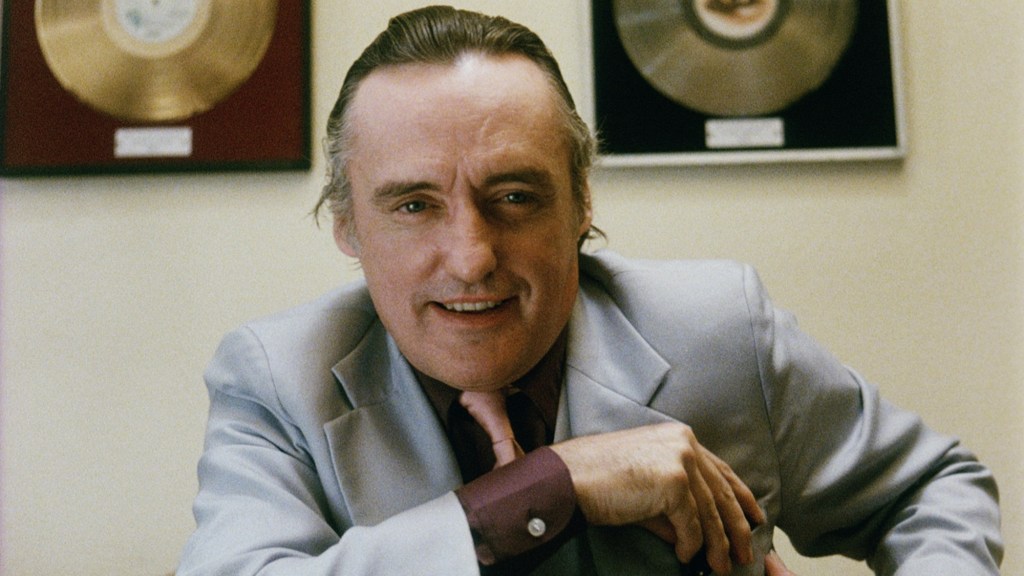
White Star (1983) was a film I was trying to track down endlessly. Ever since I read about it in a Joe Bob Briggs Top 5 Dennis Hopper performances that he penned in the Eighties. No Blu-Ray release, not on any streaming service – well, turns out all I had to do was type “Dennis Hopper full movies” into YouTube and there you have it. White Star has a dubious reputation as it was filmed at the height (or depths) of Hopper’s drug and alcohol addictions, well before he cleaned up and had an acting comeback in the mid-1980s. Here, in Berlin with director Roland Klick, Hopper has the dead-eyed intensity and animated hand movements of say Apocalypse Now, but in a low budget production and with an air of sad desperation. Some of this works for the character, Barlow, an American music manager who has latched onto a young, blonde dude named Moody (Terrence Robay) who is launching a solo career as a synth wave artist after playing in a punk band. Hopper’s character is maniacal and unpredictable, staging riots and violence by booking Moody at a punk venue where the audience wants his blood, manufacturing drama where there is none. Yet its also clear that Hopper the actor is in rough shape himself, often with a hoarse voice in a few scenes or trembling hands (apparently he could only film for two hours a day, didn’t remember the script and was allegedly medicating himself heavily). Anyway, the movie has pretty blunt points about the music industry and Barlow’s unhinged, crooked shenanigans revolve around creating spectacle for media coverage, all the while yelling about, “the future, man, the future!”. The low budget is obvious in some scenes that attempt to convey how much Moody is having an impact on the city, and sometimes a scene might be missing or just generally misshapen. I also watched an English language version where the minor characters are dubbed with American accents, adding to the surreal vibe. David Hess (from Last House On The Left) is also in this as Hopper’s right hand man, the guy who can be paid off to throw a rock in a window store and blame it on Moody’s show, and he was great. White Star will not be for everyone, but I found it compelling, particularly Hopper’s hectic, bedraggled energy, and the Berlin setting as an environment for his trench-coated, chain-smoking, shouting presence. His monologue in a laundromat about being a tour manager for The Rolling Stones is a hypnotic sequence: “We used to have stars, man, real stars.” Recommended.

