I may not intimately understand an immigrant’s perspective or be tapped into the historical context of martial law being declared in Poland between 1981 and 1983, but there’s a scene in Moonlighting (1983) that is universally relatable when a skip bin is organised and our characters wake up to find it already filled by their neighbours. That, and when they attempt to do the same in kind, they are caught and chased. The rules don’t apply to everyone, particularly the unwritten social rules.
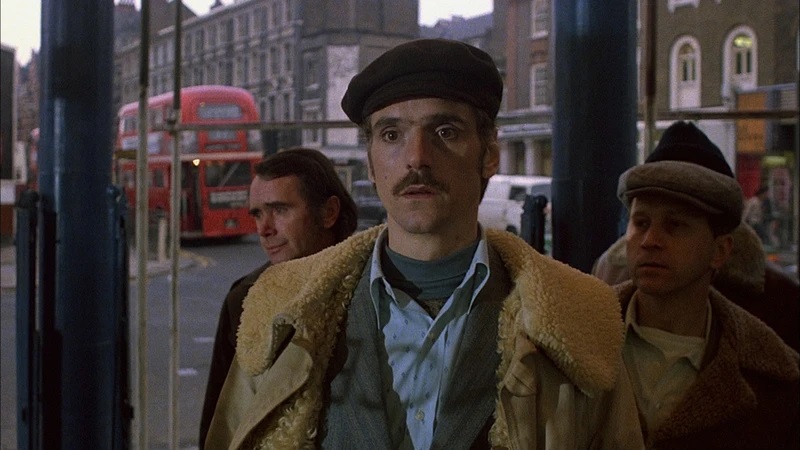
Moonlighting had always sat on my Watchlist, mainly added because it stars a young Jeremy Irons in the lead, and was written and directed by Jerzy Skolimowski, a Polish director who I had only seen one of his films previously (the strange British horror film, The Shout). From the opening scenes, which convey an airport suitcase inspection in a strange, surreal manner, and the score by Stanley Myers with Hans Zimmer often aiming for a brooding soundscape using synthesisers, I was taken a little bit aback by the film from my initial impressions. What follows is a dark satire mainly communicated through Nowak (Irons) whose narration and perspective are our guiding light into a murky situation. Nowak is Polish but is the only one of a four man crew who speaks any English. He acts as the interpreter, foreman and leader as they arrive in London to illegally renovate a townhouse in West London. Working around the clock, and living in the rundown house, they are the cheap option for the Polish official who owns the place. Their only communication back home is through a nearby payphone booth, which is handled by Nowak. During one call, Nowak comes to realise that a military coup has happened in Poland. Understanding that they are cut off and no flights are available, Nowak keeps the information secret and pushes the men to complete the job.
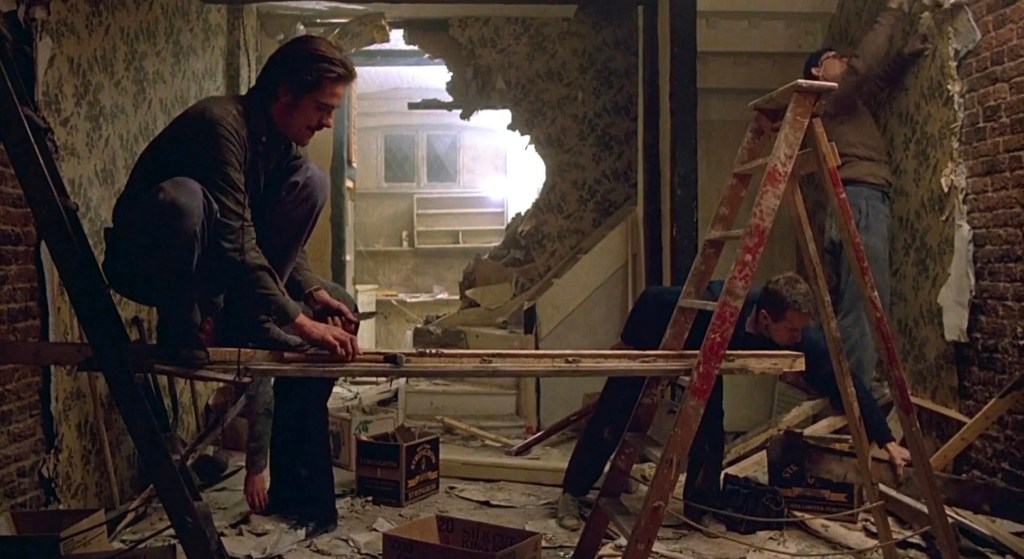
Moonlighting was apparently organised quickly by Skolimowski in response to the unfolding events in Poland, and utilised his own townhouse that was undergoing renovations as the film’s setting. Irons is excellent, conveying sweaty tension as he proceeds to increase his position of power towards the other workmen, while beginning to shoplift as a way of stretching his budget out while feeding the men with soup and drink. London is rendered as a hostile and alien environment, as neighbours and shop-keepers and people on the street view Irons with suspicion. Skolimowski moves the camera and creates juxtapositions for eerie effects, emphasising the absurdity of the power dynamics and how Irons functions inside the house and outside the house. In certain sequences, Myers and Zimmer really go for it with the synthesiser, heightening the suspense. Even removed from the specific Polish context of its making, the perspective and reception of immigrant workers within British society still has an impact, and remains a compelling, funny and ultimately resonant drama.