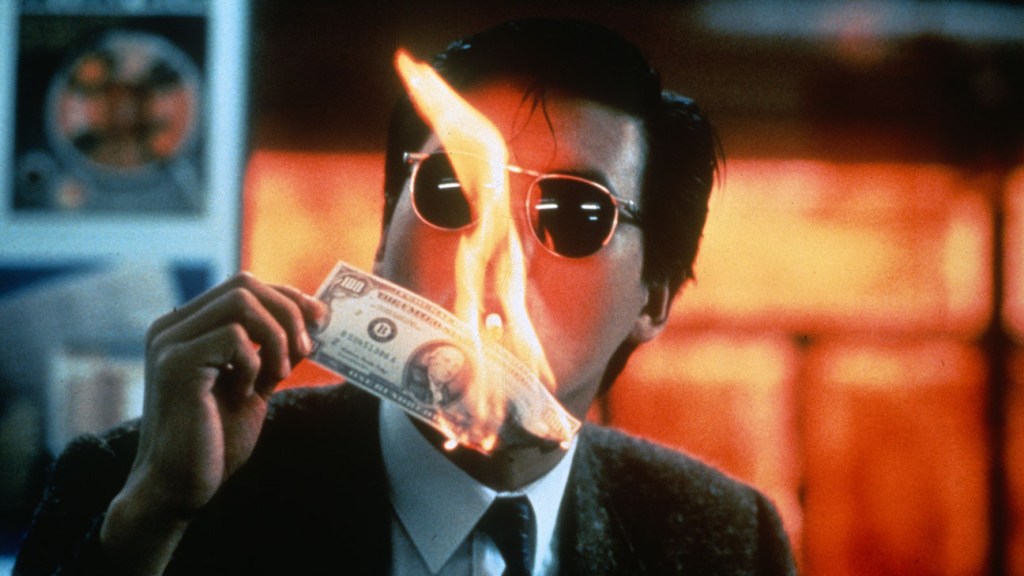
The iconic image from A Better Tomorrow (1986) is Chow Yun-Fat as the triad gangster Mark wearing dark sunglasses and lighting a cigarette with a flaming bank note, a counterfeit note incidentally. Lesser known is the sight of Yun-Fat wearing a pilly sweater with a pattern of beaded colours in a night club and still looking like the coolest guy around (helps that he’s also chewing on a matchstick while simulatenously smoking a cigarette). Because of his character’s distinctive style (influenced by Woo’s love of Alain Delon in Le Samourai), trench-coats became popular in Hong Kong (or so the legend states in imdb dot com trivia/wikipedia factoids ). Already being a fan of Yun-Fat’s collaborations with John Woo, the action epics, The Killer and Hard Boiled, it sometimes feels reductive to go back to where it all began when you’ve seen what heights they’ve scaled. A Better Tomorrow wasn’t Woo’s first movie but it was his first success, produced by fellow director Tsui Hark, a film that pioneered Woo’s distinctive approach to action cinema, influencing both Hong Kong and international cinema, and birthing the ‘heroic bloodshed’ genre. When Chow Yun-Fat enters a nightclub in slow motion to assassinate a target, it’s a sequence that basically sets the blue-print for action cinema for the next successive decades. Yet Yun-Fat is not even the main character, one of a trio of characters that the movie focuses on including Sung Tse-Ho (Ti Lung), a triad henchman along with Mark who works for a successful counterfeiter, and Sung Tse-kit (Leslie Cheung), Tse-Ho’s younger brother who is training to be a cop. Alternating scenes of hyper-kinetic action – complete with chaotic pyrotechnics, balletic stuntwork and slow-motion accentuation – with scenes of high melodrama as the theme of ‘brotherhood’ is wrung out for emotionally charged dialogue scenes. When Sung Tse-Ho is betrayed and imprisoned because of a deal in Taiwan, there is a time jump of several years and the winds of fortune have changed in the fall-out, with low-key lackey Shing (Waise Lee) now in charge of the criminal organisation. As the released Sung Tse-Ho attempts to lead a straight life and is torn between his resentful cop brother and his fallen triad ‘brother’, everything is set in motion for a bloody confrontation. With a smooth jazz (score by Joseph Koo, and themes that would influence future Hong Kong cinema including Infernal Affairs (yet also synthesise Woo’s own influences like Martin Scoresese’s Mean Streets), A Better Tomorrow was great viewing, particularly to witness it as evidence of Yun-Fat’s mega-wattage charisma as the volatile yet loyal, devil-may-care Mark. Streamed a 4K copy that was uploaded onto YouTube. Recommended.

