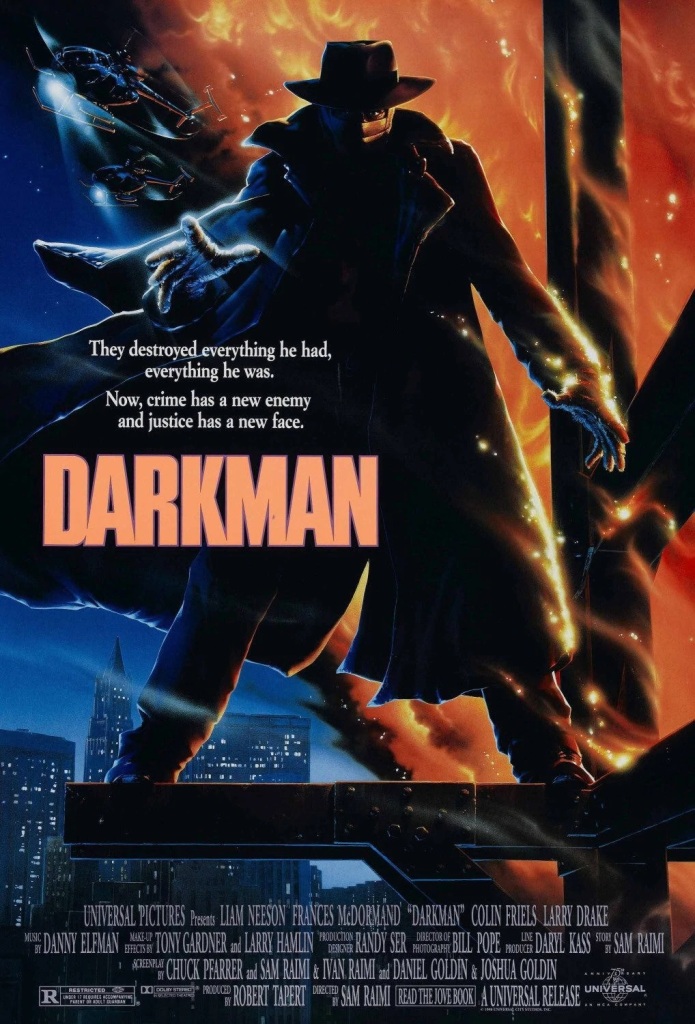
There’s a scene in Darkman (1990) that had me pumping my fist in giddy delight. Liam Neeson plays Peyton Westlake, a dashing scientist who is trying to crack the code of developing synthetic skin for grafts, and whose experiments have been failing, the cells breaking apart. When the power goes out in Westlake’s home laboratory with his assistant watching, the cells hold even longer due to the darkness (something to do with photosynthesis). Neeson steps into the shadows, a strip of light cast across his eyes, pondering, “What is it about the dark? What secrets does it hold?” I was just so tickled with director Sam Riami’s heightened style here, a scene that harkens back to classic gothic horror melodramas, and this film is a tribute no doubt to the type of movies that inspired Riami as a youth, everything from the classic age of Universal Monsters to Roger Corman’s Edgar Allan Poe adaptations to Hammer Horror. A comicbook movie not based on any comicbook, instead an original idea by Riami when he couldn’t get the rights to adapting The Shadow, Darkman is a movie that stirred my imagination when I was a kid reading comics and seeing the John Alvin illustrated poster advertised in its pages; Liam Neeson wasn’t a big enough star to have his name headlining and it was mysterious, the dark figure in a hat and coat reaching out to you. I taped it off TV and unfortunately the last 15 minutes were cut off, but I would just rewatch it knowing I was missing the ending (truly bizarre to remember that I would just rewatch incomplete movies due to the tape running out or the timer stopping short).
Darkman arrives at a particular point in Hollywood with the mega success of 1989’s Batman ushering in a wave of comic book movies, but it’s also Riami’s next movie after Evil Dead II and his first for a big studio. The imagery also hits at a time when the wave of horror movie franchises are cooling off, yet it stands in between Freddy Kreuger’s pop culture appeal and something like Clive Barker’s Nightbreed, grotesque monsters promoted to a mass market audience. When Westlake’s lawyer girlfriend, Julie (Frances McDormand) uncovers real estate corruption involving a developer Strack (Colin Friels doing an American accent) and sadistic gangster Durant (Larry Drake), Westlake is inadvertently targeted, with his lab and assistant destroyed in the search for key evidence. Electrocuted, thrown into acid and blown up, Westlake survives disfigured, a walking ghoul wrapped in bandages, also receiving the mixed blessing of a medical experiment (as a washed up John Doe) that has severed his pain receptors, which has left him with super-strength and emotional instability. Escaping and reviving his lab in an abandoned factory, Westlake attempts to perfect his skin graft to reclaim his past with Julie while also plotting revenge against those that took away his old life. Neeson’s operatic performance is really great here, evolving and alternating between misery and nastiness, and is keyed into Riami’s signature over-the-top style with dutch camera angles, rear projections, film noir/horror lighting, montages, camera zooms, etc.
A key scene became a bit of a viral point, the ‘Pink Elephant’ scene at the carnival, which is better experienced than described. And while some might mock or belittle the sequence as being bad and silly, to me, it’s a clear example of Riami’s trademark approach, going for extremes that border between campy and maniacal. The movie moves at a clip, and doesn’t spend too much time on the villains – both Friels and Drake are great – and any of their back-story, nor does McDormand really escape the boring ‘girlfriend’ nature of her part. Most intriguingly more time is spent on charting Westlake’s mood swings, and his melancholy loner status, a twisted and grotesque avenger, The Phantom Of The Opera as Frankenstein’s Monster. You can feel Riami clamping down on some instincts to make a mainstream experience, in regards to grotesque violence or gothic gore, and at times the dark satisfaction of the revenge can feel a bit reined in. There’s also the older era of action cinema, the physicality of seeing a stunt-man dangled off a helicopter by a rope while explosions are set off on a city bridge, intermixed with Riami’s use of pre-CGI back projection. While Darkman may be flawed in some ways, I love the flaws and think its a fantastic cross-genre concotion of horror, detective noir and superhero adventure, particularly shot through with the distinctive feel that Riami provides alongside Danny Elfman’s fantastic score, Bill Pope’s cinematography and Tony Gardener’s make up effects. Available to stream on iTunes. Recommended.

 VHS Tracking