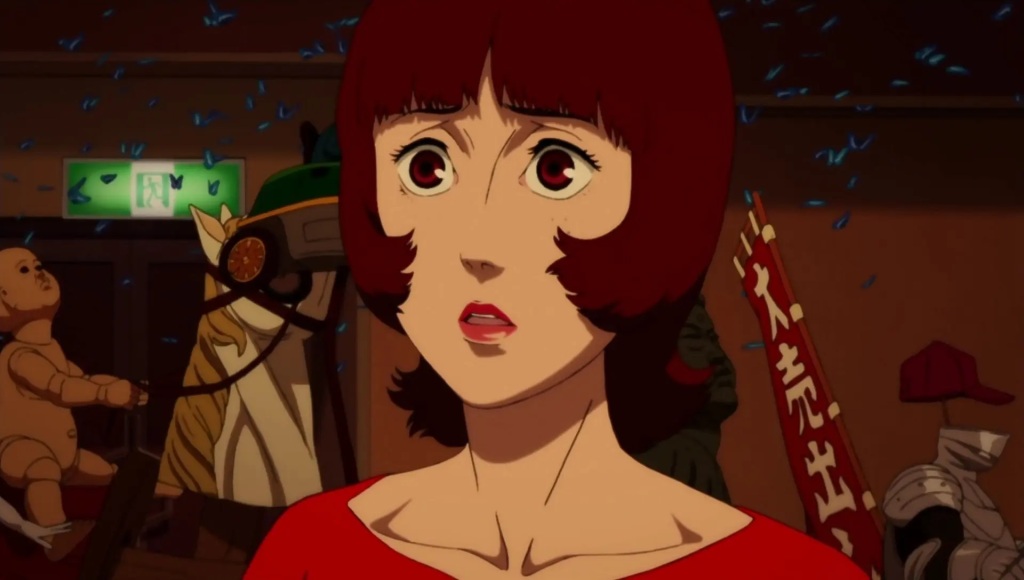
Look, I can rewatch Inception anytime, but after my first viewing at the cinema, I remembered thinking, “The imagery wasn’t really that surreal for a movie about dreams.” Sure, there’s the city folding on itself, and the hallway zero gravity fight, but for the most part, it’s pretty standard stuff – the climax is a snow fortress siege, for crying out loud. Trust in Paprika (2006; Papurika), which is already tied to Inception by many seeing it as a clear influence on Christopher Nolan’s film, to fully embrace the surreal; this is a Japanese anime that is a bright, colourful, dazzling collection of images. Here, a key image denoting the collapse of dream logic into the real world is a circus parade where people start to crack up and lose themselves in chaos. Based on a novel by Yasutaka Tsutsui, Paprika was itself a long awaited dream project for director Satoshi Kon (Perfect Blue) that was was sadly his last, dying of cancer four years after its release. In a clinic where therapists use futuristic technology – a device called a DC Mini – that can allow people to observe and interact inside a patient’s dreamscape, an unknown assailant has stolen one of the devices, and is using it to create havoc, invading people’s subconsciousness and causing them to lose any distinction between reality and the subconscious. Doctor Atsuko Chiba uses it to treat patients as their alter-ego, Paprika, who is buoyant and extroverted whereas Atsuko is stern and introverted. Along with the tech crew, and a haunted police detective (who looks like J. Jonah Jameson) that Atsuko is treating, the team chase the dream assassin through guises and references. The strong underlying theme is the movies themselves as a dream machine that breaks down reality (I was delighted when a character discussed movies in a dream and they resemble Akira Kurosawa). While not as fucked up as Perfect Blue, there are still some eerie and gnarly moments, providing a dark undercurrent to the visual confetti that feels like the movie’s main aesthetic gear. I really enjoyed Paprika and its artistry, not just visually and conceptually, but also in its basic storytelling and finding moments of humanity and tension within this weirdness. Rented it on iTunes. There is a great NTS Sounds Of The Screen: Satoshi Kon mix by Florence Anderton-Scott out there on their website, basically the thing that inspired me to watch Paprika; Susumu Hirasawa composed the music for this film. Recommended.

 VHS Tracking