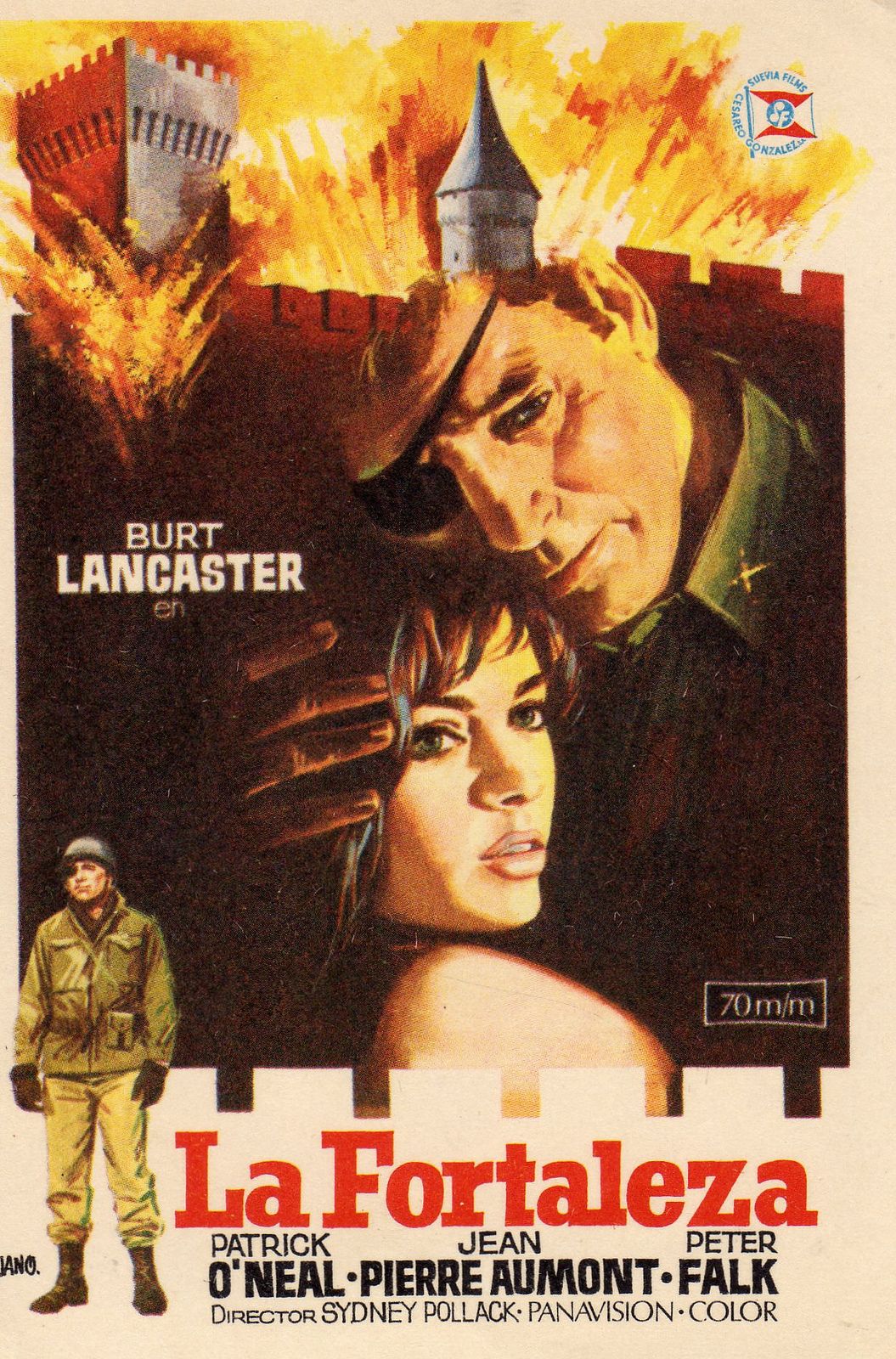
While the posters might make Castle Keep (1969) look like a World War II action movie, it’s actually a very strange, oddball experience. Right from the opening sequence where a jeep of tired soldiers travelling through a forest is cross-cut in the editing with two stately people – a Count (Jean-Pierre Aumont) and a Countess (Astrid Heeren) – riding their horses through the trees, French land owners who reside in a nearby castle, there’s the clear influence of the European New Wave (Fellini, Godard, Bergman, etc) on this American film directed by a young Sydney Pollack. Based on the novel by William Eastlake and released during the American involvement in Vietnam, this is a surreal art movie for the most part, reminiscent at times of Catch-22. Led by a one-eyed Major Falconer (Burt Lancaster), their mission to secure the Castle Keep as a defensive line becomes a waiting game, a hang out in purgatory. While one of the troop, an art historian (Patrick O’Neal) becomes attached to the history of the castle and the art and antiquities it keeps, Major Falconer is more interested in bedding the Count’s niece who is his wife (!), and doesn’t care if the castle is blown to pieces if it means the Germans do not get to occupy it. The other men bickering in wry, philosophical, jaded conversations fall into other reveries: one man Lt Rossie (Peter Falk) finds himself abandoning his post to become a baker in the nearby town, one is a writer (Al Freeman Jr) taking everything down for a possible novel, another (Scott Wilson) falls in love with a Volkswagen (!!). It’s the type of movie where you are not surprised when Bruce Dern turns up as an unhinged Jesus freak conscientious objector. Again, a strange, odd film with lighting reminiscent of a Roger Corman Edgar Allan Poe adaptation and other times an almost psychedelic approach to the war setting. Some might find it too hip or trying in its artiness; I thought it was quite excellent, though the destructive climax is a bit more conventional in its tragic ‘war is hell’ motifs. Michel Legrand provides the score. Rented from iTunes. Recommended.

 VHS Tracking