I distinctly remember seeing Johnny Mnemonic (1995) at the cinema when I was a teenager and afterwards trying to convince myself it was good. That it was worth the pocket money I spent on the ticket. Like most people, I was hoping for a great Keanu action movie like Speed. It wasn’t that; it was a bit weird, with Keanu not really being a hero but a petulant yuppie burn-out, and there was a psychic dolphin at the end. And it wasn’t The Matrix, which really pushed things forward for action, cyberpunk and sci-fi cinema.
Now, dusting off my DVD copy of Johnny Mnemonic because I’m in a cyperpunk headspace, I have learned to stop worrying and love the bomb. I’ve always rewatched Johnny Mnemonic every few years to see if I’ll reappraise it, and look, it’s still an interesting failure (it was a critical and commercial flop) but I think it has value. Based a screenplay by author William Gibson – whose sci-fi work defined cyberpunk in literature – based on one of his short stories. Directed by artist Robert Longo whose plans for a low budget Alphaville type of arthouse sci-fi thing were thrown by Keanu’s attachment, the box office success of Speed and the studio’s input to make it more commercial. A ‘Mnemonic’ is a courier who carries data in a cranial implant; Johnny (Reeves) is basically a walking hard drive and he takes a dangerous job for the money so he can buy back childhood memories that he dumped for space. Uploading considerable data from a mysterious group, Johnny travels from Beijing to New Jersey, finding himself on the run from the Yakuza (led by Denis Akiyuma and his laser thumb), his double-crossing manager (Udo Kier, perfect), and a cybernetic Jesus freak assassin (Dolph Lundgren, funny). Employing a body guard for help (Dina Meyer), there’s also a group of rebels named the Lo-Teks (headed by Ice T, one of several sci fi movies where he played a resistance leader).
Johnny Mnemomic might not be objectively good. It isn’t the serious, artistic triumph William Gibson readers were maybe hoping for, and obviously lives in the shadow of Blade Runner. But it’s still fun because of the 1990s cyber-noir aesthetics and interests that the movie is mired in, the eclectic, great cast (this also stars Henry Rollins and Takeshi Kitano!), and its dystopian world-building (set in 2021 when a virus is ravaging the global population). That, and how goofy it is. The movie is most alive in the first half where it keeps throwing new characters and ideas at the viewer; there might be too much running around deserted junkyards at night for me when it gets to Newark. Still, it also has a psychic dolphin and an internet “ghost in the machine” of a former pharma CEO as well.
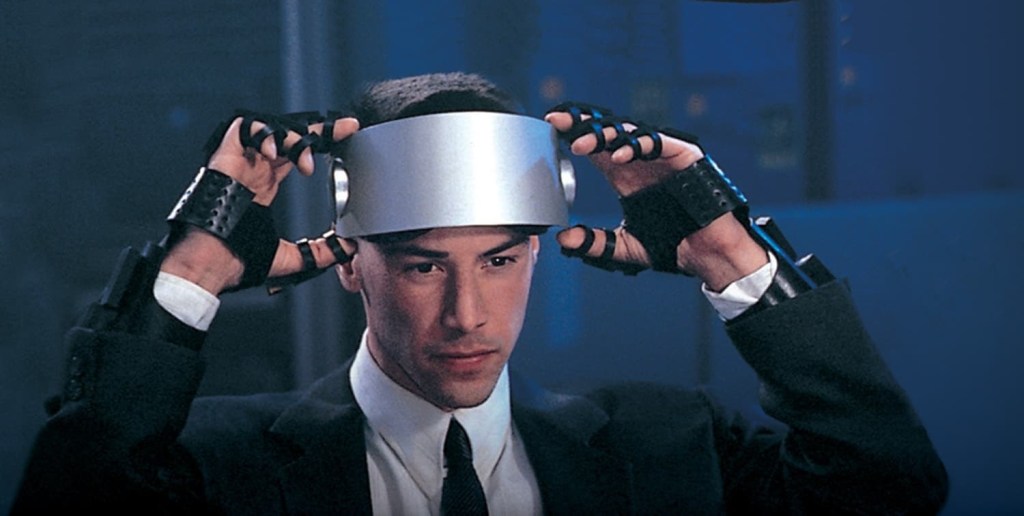
When I was a kid, I just wanted good action scenes; I remember being bummed out that Johnny only used the blaster he was brandishing on the poster for one scene. These days I’m just delighted to see a young, impetuous Keanu in a sharp suit strap on some Brainstorm gear onto his head and clench his teeth before jacking into the internet. “Hit me.” Smash cut to an industrial/techno soundtrack (crank up the Orbital) and polygon VR graphics (floating Keanu avatar), and I’m in cyber-heaven. I’m also keen to see both the Japanese cut and Longo’s black-and-white edit at some point. Recommended, if you can handle the data space.

 VHS Tracking