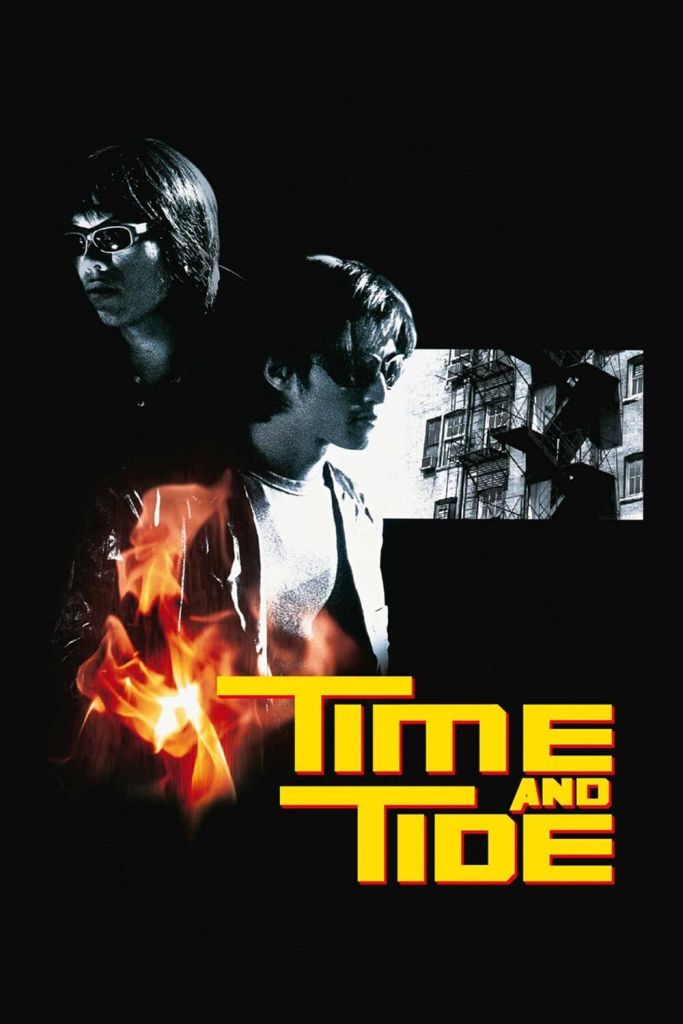
After recently enjoying Hong Kong director Tsui Hark’s collaborations with Jean-Claude Van Damme, Double Team and Knock Off, for their visual kinetic energy and their “what the fuck” madcap action, it was a welcome surprise to discover his return to Hong Kong action cinema, Time and Tide (2000), was available on Netflix in Australia. Now while at the time those JCVD vehicles were viewed as bombs and evidence of a downward trajectory in the action star’s career, they have cult fans now (including myself) – yet Tsui Hark wasn’t happy with them and the lack of control he had working in the Hollywood system. With Time And Tide, it doesn’t quite start out as a classic action movie and for a time, I was wondering when the main plot or hook would actually begin. We mainly spend time with the character, Tyler (Hong Kong pop star Nicholas Tse) who narrates the movie and is a young cool bartender who winds up on a bender with a woman, Ah Jo (Cathy Tsui) over one wild night. The next morning Tyler discovers Ah Jo is a cop and then several months later also finds out she’s pregnant. Yet this is all set up, alongside Tyler’s work as a unlicensed bodyguard for Uncle Ji (Anthony Wong). There’s also a heist in Spain where a police unit gets wiped out by a team of toughs. Eventually we meet Jack Chow (Taiwanese rock singer Wu Bai), a lowly worker who also has a secret past as a mercenary, and he’s moved to Hong Kong to be with his pregnant wife Ah Hui (Candy Lo). Tyler and Jack become friends, but are also on opposite sides when Uncle Ji’s bodyguard team has to protect the gangster who wants back his stolen loot from former employee Jack. I don’t know if my explanation is any clear, but the film itself is not much better and apparently went through an extensive post-production editing to get it down from its original 3 hour run time to something under 2 hours. In any case, just let yourself go from logic and enjoy the way Hark moves the camera around with fluid movements, memorable framing, and hectic editing. There’s a touch of the Christopher Doyle about the cinematography but married with some 2000s-specific post-Matrix bullet-time and CGI work. From the Trainspotting poster in Tyler’s apartment to Jack’s Gallagher Brothers hairstyle, there’s a feeling that the movie is responding to cool late-1990s culture, feeding off the international absorption of Hong Kong action cinema throughout that decade, a style that Tsui Hark helped pioneer with John Woo and Ringo Lam. As each shot zooms around, the propulsive style expands time within the set pieces as every moment is adrenalised or aestheticised. In any case, as the movie continues, it becomes more involving, particularly in some key action spectacle set pieces including a stake-out at Jack’s apartment that blows out into a shoot-out chase across and down the sides of the tenement buildings, or the airport climax that involves someone giving birth while tear gas and bullets fly. It’s nuts, deliriously enjoyable if you’re into its rhythms and cool, laconic twin heroes. Recommended.

 VHS Tracking