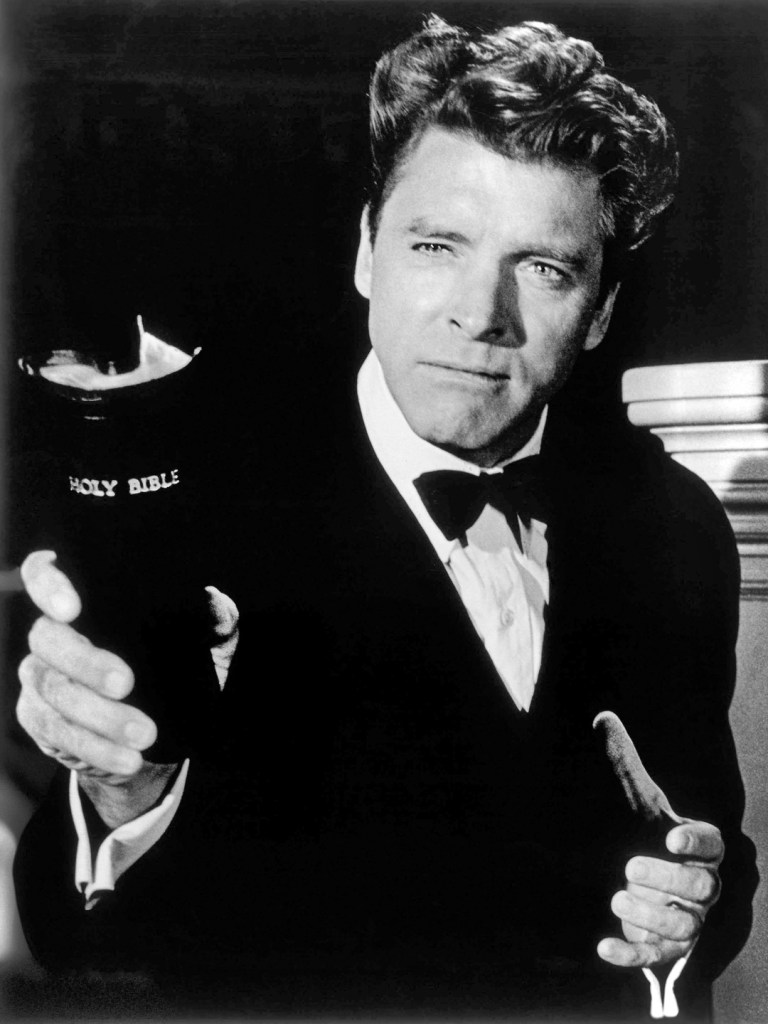
Watching a few Burt Lancaster movies recently and I was contemplating him as an actor, how he fills up a frame with his tall, athletic physique and his garrulous, charismatic, confidence. Lancaster won the Oscar for Best Actor for playing the title role of Elmer Gantry (1960), based on the Sinclair Lewis novel, and it is a showy, big and bold character, which the actor plays to the tilt, all rockets blazing. The first scene finds Elmer Gantry in a bar, a fast-talking salesman telling dirty jokes to the fellas and eyeing the shape of a dame at the bar. Yet we follow his travels as he starts to schmooze his way into the world of revival tent preaching, drawing on his own history as a seminary school drop-out (expelled for lewd behaviour, we find out) to claim his stake in this growing industry as a “reformed sinner”. The success of Sister Sharon Falconer (Jean Simmons, excellent) and her touring tent show offers Gantry someone to turn his talkative charms onto. As Gantry becomes a popular fire-and-brimstone preacher, journalist Jim Lefferts (Arthur Kennedy) keeps a wry eye over everything, and particularly causes a stir when an editorial denounces the congregation’s move to a big city centre (cue timely scenes of Gantry whipping up his congregation by denouncing the newspapers as “fake”). Shirley Knight is also great in the later half as Lulu Bains, a sex worker who was also an intimate acquaintance of Elmer’s back in the day, and aims to get revenge on Elmer’s sanctimonious agitation against illicit businesses. The first half is strong satire on the ghoulish faces in rapture at Gantry’s absurdist speechifying, but I was surprised to see how the movie allows its characters to be sincere and that the emotional relationships become more layered than simply being a critical take-down of religious business. As a big budget Hollywood drama, it is long, colourful and broad, but also feels like an influence on later movies like PTA’s There Will Be Blood or The Master in its motivated, morally dubious protagonist and particular the latter film’s interest in an American society that feels lost and lonely, seeking some form of guidance that is both entertaining and “spiritual”. I thought it was great. Directed by Richard Brooks and based on the novel by Sinclair Lewis. Available to stream on Stan. Recommended.

 VHS Tracking