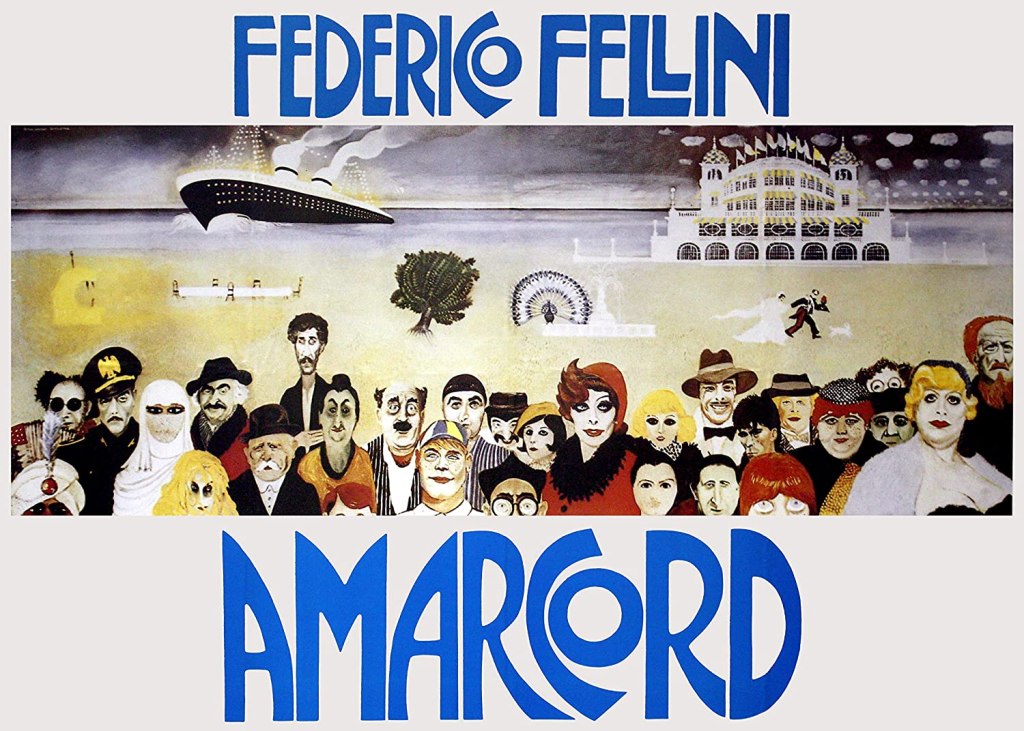
I really became swept up in Amarcord’s (1973) approach to depicting a place, a time, a memory. Directed by Federico Fellini, and while not strictly autobiographical, the film is based on his memories growing up, set in the village of Borgo San Giulano during the 1930s and Benito Mussolini’s Fascism. Rather than having one character as an adult narrate a series of flashbacks, as a more mainstream movie might, Fellini takes a stylistically unique approach, having different people in the town initially speak to the camera – a toothless street person, a long-winded historian who is always rudely interrupted – and observe different pockets of the townspeople, eventually returning to one family and their eldest son Titta Biondi (Bruno Zanin) who looks overgrown in his school boy cap and short pants. There’s one thread of this film that feels like an influence on every randy teen movie afterwards as boys in a Catholic repressed upbringing obsesses over voluptuous bodies and masturbate constantly. Titta’s own obsession is with the glamorous Gradisca (Magali Noel) who waltzes around town like a movie star to everyone’s adoring glances even as rumoured stories about her past become the stuff of myth. Amarcord doesn’t settle into a conventional narrative and has a season structural, moving along in time and taking in another set piece. Opening with a burning ceremony in the town square to the visit of a National Fascist Party official (where most of the towns people are in uniform and happily celebrating) to the oppressive fall out when a gramophone playing The Internationale is discovered. Ostentatious pageantry continues – from school classes to races to weddings – and people of all shapes and sizes, many non actors, are focused upon by the camera. We see reoccurring townspeople and everything is touched by celluloid dreaming from the popularity of the local cinema; the daydreaming fantasies involve larger than life scenarios. When the townspeople all sail out to see the SS Rex, a mammoth ocean liner that is the pride of the government, Fellini shoots it like a big fake prop. In time, there are dark harbingers of what is to come in the following decades, but also the nostalgic rumination of dying family members, local personalities leaving, and rare moments of beauty and grace amongst it all. I was really into its plotless reverie of Amarcord and how it told the tale of a community, both with bemused satire and warm longing, no doubt the Felliniesque influence on everyone from Monty Python to Wes Anderson. The immediately recognisable score is by Nino Rota, cinematography by Giuseppe Rotunno, and it was a critical and commercial success upon release (winning the Academy Award for Best Foreign Picture). Available to stream on the Criterion Channel. Recommended.

 VHS Tracking